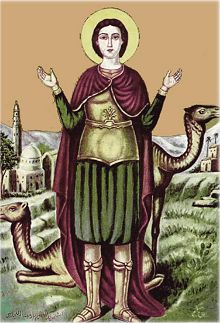
 St. Mina the Miracle Worker St. mina is considered the most well know saint in the East and the West, due to the many miracles that are performed through his prayers for us. That is evident in the numerous little clay bottles on which his name and picture are engraved. These were discovered by the archeologists in diverse countries around the world, such as Heidleburg in Germany, Milan in Italy, Dalmata in Yugoslavia, Marceille in France, Dengela in Sudan, and Jerusalem. Visitors from these cities and others would buy these bottles which usually contain oil or water for blessing, and take them back to their relatives. Saint mena was born in Egypt in the year 285, in the city of Niceous which lies in the vicinity of Memphis. His parents were real ascetic christians, his father's name was Audexios and his mother's was Aufimia. On the feast of St. Mary, the mother who did not have any children was praying in front of the Icon of the Virgin with tears that God may give her a blessed son. A sound came to her ears saying "Amen", and thus she called her son Mina. His father, a ruler of one of the administrative divisions of Egypt died when mena was fourteen years old. At fifteen he joined the army, and was given a high rank because of his father's reputation and was appointed in Algeria. Three years later he left the army longing to devote his whole life for Christ. He headed towards the desert to live a different kind of life. After he spent five years as a hermit, he saw the angels coronating the martyrs with glamorous crowns, in a revelation and longed to join them. While he was think- ing about it, he heard a voice saying: "Blessed are you Abba mina because you have been called for the pious life from your childhood. You shall be granted three immor- tal crowns; one because of your celibacy, the second because of your asceticism and the third because of your martyrdom". Immediately he felt as if the earth under him was vanishing, and he was overwhelmed with great eagerness to be carried away to heavens. In a mood of valor he hurried to the ruler, declaring his Christian faith. His endless sufferings and the tortures that he went through, have attracted many of the pagans not only to christianity, but also to martyrdom. The saint's assassins tried to burn his relics but they failed, so the believers loaded his body on a camel and headed towards the western desert. At a certain spot, the camel stopped and the people could not force it to continue its trip by any means. Right there; hear a water well they burried him (that place is his present monasterS at the end of Marriute lake not far from Alexandria). It happened that while a shepherd was feeding his sheep in that area, a sick lamb fell on the ground. As it struggled to get on its feet again, its scab was cured. The story was spread quickly and the sick who came to this spot recovered from whatever illnesses thay had just by laying on the ground. During that time, the daughter of king Zinon, the Christ lover, caught the itch. His advisors suggested that she should try that place, and she did. At night the Saint appeared to the girl and informed her that his body is burried in that place. The follow- ing morning, she bathed in the well and was healed. She related her vision about St. mina to her servants and that he cure Immediately, King Zinon ordered the Saint's body to be dug out, and a church to be built there. Not only that, but he also ordered to build a large city to be named after the Saint. Sick people from all over the world, used to visit that city and were healed by the intercession of St. mina, the miracle-maker. Mrs. Bucher recorded that destruction started to take place in the city, and its in- habitants were degraded after the Arab conquest. During the period after Haroun El-Rasheed, the Barberians attacked the city and burned a large portion of it. At the time of El-Mamoun he ordered to put the entire city down, and then he used its numerous marble pillars to build his palace and the mosques. It is only in the twen- tieth century that international missions began to search for the city and the church. The remainders of it, no dou As soon as Pope Cyril the Sixth was coronated on St. Mark's Throne, he began to put the foundations of a great Monastery close to the remains of the old city. Thus in his blessed days God's will had permitted the old monastery of St. mina to be resurrected and the Copts to visit it and to be blessed by the Saint. What is even more interesting is that the Pope has stated in his will that his body should not be burried in the new famous Cathedral in Cairo, but in the monastery of his personal friend and intercessor St. mina the miracle-maker. |
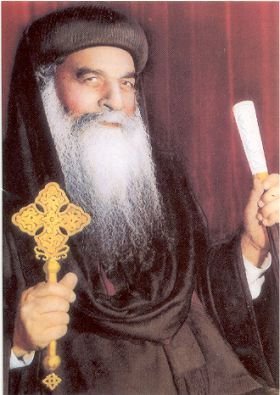 The Departed, His Holines Pope Cyril (Kyrillos) VIThe 115th Successor to St. Mark the Evangelist (1902-1971) On March 9 (Amshir 30), the remembrance of the departure of the Great Pope (Papa Ava) Kyrillos (Cyril) VI, the 116th successor of St. Mark the Evangelist. He was pope of Alexandria and Patriarch of the See of St. Mark befor our present pope, Papa Ava Shenouda III. Anba (His Holiness) Kyrillos was a holy man who through full dedication to the life of prayer and fasting posessed many higher gifts which included performing wonders and miracles, the gift of knowledge, and an unusual ability to lead by example. which was missing for generations before his ascending to the throne of St. Mark. He set on the chair of St. Mark for twelve years (1959-1971). He had the honor and showed the wisdom needed to guide the Coptic Church through the difficult times of the 1960's when the government of then Gamal Abdul-Nasser was nationalizing business, real estate, and land including those willed to the churches and monasteries. He was highly regarded by the people of Egypt from all walks of life Christian and non-Christian alike. Pope Kyrillos VI was born August 2, 1902 as Azer Ata, the son of a church deacon from a middle class family. After completing high school, Azer went to work for a shipping company in Alexandria. Much against his family's wishes, he resigned his job with the intention of becoming a monk and entered the monastery of Baramous (named after Sts. Maximus and Domadius) in the Western Desert of Egypt in an area called bariaat Sheheet (the prairie of the heart's scale). On the 25th of February, 1928, he was consecrated monk. He was given the monastic name "Mena" after St. Menas his patron saint. Three years later he was ordained a priest, July 18, 1931. Fr. Mena attended the Helwan Theological College and was rated one of the top students. Later, he retired to a cave two miles away from the monastery to live a life of solitude. That is how he came to be known as "Abouna Mena Al-mota-Wahed" (Fr. Mena the Solitaire). Afterwards, he was appointed abott of the Monastery of St. Samuel in the eastern desert, south of Suex near the Red Sea. He devoted a great deal of effort toward the restoration of this historic landmark. When the monastery of St. Samuel was restored, he left that area and moved to a deserted windmill south of Cairo (the windmill belonged to the Army, and long after, it was revealed that he paid a nominal rent for it when he found out that it belonged to the Army). This is near the historic region of "Masr Al-Kadema" (ancient Cairo). He restored the place and built a small residence and a church on the name of St. Mena his patron saint. He found himself surronded with college students, many of them are from outside Cairo, so, he started a dormitory for students who neede this service. This informal program produced the first church affiliated dorm in modern times in Egypt, and produced countless church leaders, some of whom are our present bishops, priests, and Laity leaders. The likes of His Holiness Pope Shenouda (his successor), the late bishop Samuel, .. etc. After the abduction of his predecessor, the late pope Youssab (Joseph) II by militant Copts, the church was in great turmoil which did not last long, because it was the will of God the pope Youssab departed shortly thereafter. In April, 1959, Fr. Mena Al-Mota-Wahed was elected pope and patriarch through the unique process used in the Coptic Church to elect a pope. Candidates for the honorable position are nominated, three or four of the nominees are elected by the Holy Synod as most qualified. The final selection is left to the will of God and the guidance of the Holy Spirit, by placing the names on the altar during the appointed day of final selection. A young deacon is then asked to draw a name which is then the one chosen by God from among the qualified candidates for this high calling. In May, 1959, Fr. Mena became pope and patriarch by the laying of the hands of all the bishops of the Coptic Church at the time, he was called pope Kyrillos VI (That means that five popes before him were called Kyrillos. The first pope Kyrillos is Cyril of Alexandria the pillar of faith). During his tenure as patriarch, many were attracted to monastic life and to the priesthood by his good example and sincere life style. As a teen-ager growing in Egypt at the time I used to attend Vespers regularly at the Great St. Mark Cathedral (Al-darb Al-wasse) in Cairo where his holiness lead the prayers and many of us had the blessing of seeing him, talking to him, and getting his blessings. He always paid attention to the people and spent many hours blessing and chatting with young and old. He always encouraged us during exams seasons, and prayed for our success. No wonder many joined the priesthood from the ranks of college graduates in all fields which was previously not considered the thing to do! Many books have been written about his life, wonders and miracles. The author recommends the publications of Pope Kyrillos the VI Society which are published originally in Arabic and translated to many live languages (English, French, German, .. etc.). We are going to mention just a few, some have not published elsewhere and was related to the author by relatives and friends: His Holiness had the gift of knowledge, so one day, he was visited by two men, one was well known to his holiness. When the gentleman introduced his friend to his holiness, Pope Kyrillos looked at the man and said: "Why don't you like us?" I love you and like to see you here always. The man was very ashamed because he thought evil of our beloved pope and had argued with his friend about the use of meeting a 'simple' man. This man became a great admirer of Anba Kyrillos and his son was healed from terrible illness through the prayers of Anba Kyrillos. Miracles of heeling and casting out of devils from a non-Christian young lady was related to me by a very dear relative. She was the daughter of his boss in a textile factory near Alexandria. She was one of 22 children, possessed by demons and was withering away. Her father loved her very much. He spent a fortune on real doctors and witch doctors as well, with no results. On day, he called my relative to his office and said, you have "Sheik Kebeer" (Great Elder)? can you introduce me to him? My relative promised to arrange a meeting, he traveled to Cairo and arranged with the pope's secretary a meeting for the afternoon of a specified date. He was supposed to meet them at the door and introduce them to the staff to take them to the house of the patriarchate. The people were very anxious, they arrived early. His Holiness recognized them although he was not told (ordinarily, people were brought in, and they told him their needs). Anba Kyrillos called the young lady by her first name. Put his cross on her forehead, she fell down sobbing. From that moment on, she was completely whole. In his last days, he was gravely ill with phlebitis (blood clot in the leg). They hooked a speaker from the great Cathedral to his bedroom at his request because he could not bear not being able to perform liturgy (which he performed almost daily during his life of priesthood). One day the head mother of one of the convents (monasteries for nuns) wanted to speak to him on the phone, but the staff wouldn't give out his private number. Anba Kyrillos appeared to her in a vision, gave her the number and comforted her. She did not call, but later on she was blessed by seeing him and was rendered speechless when Anba Kyrillos asked her the reason she did not call on his private line. Our Father Papa Ava (the Great Pope) Kyrillos departed on March 9, 1971. Shortly before his departure, he told one of the monks, you look like Tobia, the one mentioned in the book of Tobeet. Take care of my burial. Initially, they buried him under the Altar in the Great Cathedral in Cairo. But when his successor, the Great Patriarch, Pope Shenouda III read his will, he had to follow his wishes and move his holy body to the desert south west of Alexandria, to the Monastery of St. Mena which was renovated and immensely expanded by Pope Kyrillos to honor his good friend, patron saint, St. Mena of Marriot. That is where his place of rest. It is the custom of Apostolic Churches to wait 50 years after departure, before declaring a person a saint. And although many in our generation feel deeply about the worthiness of Anba Kyrillos, we anxiously are waiting until this day comes. His prayers and the prayers and intercessions of his patron, Saint Mena of Marriot be with us. Glory be to God forever. Amen. |
 St. Anthony is considered the father of all monks and one ruler of Christian Monasticism. He was born at about the year 250 A.D. in a city in upper Egypt called Kamen-El -Aroos, city of Beniswef. His father died before he reached the age of twenty. He heard the deacon in the Church reading this verse of the Bible:" If thou wilt be perfect go and sell that thou hast, and give to the poor, and thou shalt have treasure in heaven" (Matt.19:21). So, he distributed all his wealth among the poor and left to the desert starting his monastical life, to where it is today near the coast of the Red sea. People started visiting him and asking him for prayers and blessings. A certain king, from a foreign land, asked him, by means of messengers to come and heal his sick son. The messengers brought gifts to St. Anthony but he did not accept them and decided not to go to that foreign land. St. Anthony prayed the same day and by the power of Jesus Christ lifting him upon a cloud, he went into that foreign land where he was invited to eat at a Minister's house. That minister had a pig whose youngsters were blind and limb, St. Anthony healed them. The king had heard of this and invited St. Anthony to his house to heal his son. He went there, healed the son and then returned to the monastery. The following day, the messengers still being at the monastery, were unaware of St. Anthony's trip and asked him to accompany them to heal the King's son. So St. Anthony asked them to return back and he will follow later. After several days of a long trip they heard about the healing of that son and thought that it was St. Anthony after they reached the King's palace but he didn't tell them so that he may avoid falling into temptation. The messengers raised God for what they had witnessed. St. Anthony passed away in the year 356 A.D. after a life full of good deeds and valuable spiritual experience. We celebrate his departure on the 30th of January (22 Touba of the Coptic calendar) every year. |

|
